
Scam Messages

Arjuna News, Cyber Fraud, investment scam, Scam Messages, Smishing Defense

Beware of mushrooming cyber investment scams

Always remember that your earnings is your effort towards getting the same. Never get carried away by the baseless expectation to add more money to kitty simply by trusting unknown weblinks without verification. Any claim promising quick money is not always a true one. Here we present to you an incident reported in The Hindu about such an attempt on an engineer couple that that substantially evaded courtesy Bengaluru Police. U.K. based investment scammers lured the woman showing quick and huge profits on the investments sought from them. They managed to get a sum up to 1.53crores transferred from the couple through many transactions, the investment scammers who got connected to the cheated ones through social media also gave access to the couple to a website to keep checking their growth which was never there. With due regards, the fishy investment group was promptly discovered and estopped by East Division of Cyber Crime police and the there was a reverse amounting to 1.4 crores from the total transfers made by couple. Not all can be fortunate like them. We urge people always wanting more money and profits accruing to them to act vigilantly. Let myarjuna.com take the lead. Our platform myarjuna.com will carry out all necessary checks on such links or webpages and act as a hurdle between your money and fraudsters. Our platform myarjuna.com wishes more and more money sailing towards you but let us foresee the icebergs and jerks in your way. Source: the hindu
Scam Messages

eChallan scam

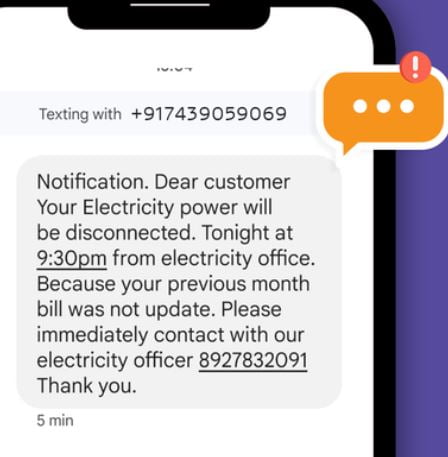
Did you receive an e-challan recently? Beware! Scammers are targeting motorists with fake traffic violation fines, and many have fallen prey to their tactics. These fraudulent messages may seem authentic with specific vehicle registration details, but you could lose your hard-earned money to cyber criminals. Don’t fall for it! Read on to discover how you can protect yourself from these scams and stay safe on the roads. Implement these simple steps today to avoid being the next victim of the eChallan scam.

Scam Messages, Smishing

India Post Message via imessage on Apple Phones

Are you also getting this message ? These are #scam Transnational Alert for iPhone users are learnt to be receiving scam messages via iMessage regarding package/courier. Clicking on suspicious links may be avoided and read receipts may be disabled for such messages. Do not click on the link if you see the following message in your inbox.“Your package has arrived in the warehouse and we tried to deliver it twice. But due to incomplete information of your address, we are unable to deliver. Please update your contact details within 48 hours by clicking on the link. If this is not done, the package will be sent back to the company.” When a user clicks on the fraudulent link and enters their details, they are redirected to a website that mimics the official India Post site. This fake site displays a random tracking ID and a delivery failure notification, urging the user to update their address. The link is designed to work only on mobile devices, not on desktops, which can be a clue to verify its authenticity. To protect against these scams, users should verify the authenticity of the sender by checking the email address, phone number, or other means.

Scam Messages

Indians receive 12 fake messages each day as scammers use AI to streamline operations

Indians received nearly 12 fake or scam messages every day with almost 82% having clicked or fallen for these messages. 49% Indians were unable to recognise scam messages due to the lack of typos or errors as the use of AI has increased the scale and sophistication of phishing attacks. While fake messages were found to use varying methods to lure unsuspecting users, most Indian consumers fell for fake jobs notifications or offers and bank alert messages, a study conducted by McAfee found. The study further revealed that Indian consumers spend 1.8 hours a week reviewing, verifying or deciding whether a message sent through text, email, social media is real or fake. And 60% of Indian respondents said it has become harder to identify scam messages, attributing this trend to hackers using AI to make their scams more believable. The study based on responses from 7,000 adults in seven countries, including India, further revealed that a new phishing site is created every 11 seconds, highlighting the need for a sustainable solution to the problem of scams. “It’s not just the speed and volume, but the sophistication. Thanks to AI it can be incredibly difficult to know if that delivery text message or bank alert notification is real or not. So much so that 73% of Indians believe they have a better shot at solving the Rubik’s cube than identifying a scam message”, Roma Majumder, SVP of Product at McAfee said. The problem of scammers making use of AI to launch phishing attacks is not new and has been reported since the availability of AI enabled tools was expanded. However, the study highlights the stress users are facing as AI has enabled scammers to increase the number and sophistication of the attacks. source “The Hindu“

Scroll to Top