Phishing

Arjuna Releases, Phishing

This Is How Phishing Looks in Real Life — And Why Real-Time Protection Matters More Than Ever

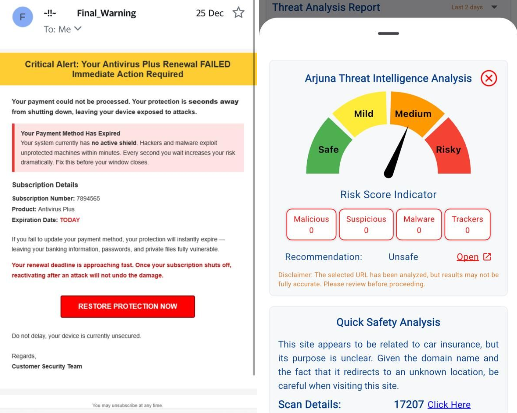
Phishing scams have evolved. They are no longer easy to spot emails filled with spelling mistakes or suspicious formatting. Today’s phishing attacks are polished, urgent, and designed to exploit human psychology in seconds. A recent real-life example highlights just how convincing these scams have become — and why relying on “being careful” is no longer enough. A Common Morning, A Dangerous Email The email looked urgent. It claimed that an “Antivirus Plus renewal FAILED” and warned that device protection was “seconds away from shutting down.” The message was carefully crafted to trigger fear and immediate action. It included: At first glance, it appeared legitimate. And that is exactly why phishing works. Why Modern Phishing Is So Effective It Uses Psychology, Not Poor Design Phishing today isn’t about obvious mistakes. It’s about pressure, timing, and emotional manipulation. Scammers know that fear reduces rational thinking. When users feel rushed, they are far more likely to click without verifying. It Mimics Trusted Brands and Services From antivirus renewals to bank alerts and delivery updates, phishing emails often impersonate services people already trust. This familiarity lowers suspicion and increases the chance of interaction. The First Click Is Where the Damage Happens Most cyber damage occurs the moment a malicious link is clicked. That single action can lead to credential theft, malware installation, financial loss, or identity compromise. How Real-Time Protection Changes the Outcome Before there was even time to react, Arjuna flagged the link as unsafe and displayed a clear risk warning. Instead of panic, there was clarity. This is the power of real-time protection: Security should not depend on users always making perfect decisions under pressure. It should intervene at the exact moment of risk. Why “Be Careful” Is No Longer a Strategy Telling users to “be careful” assumes unlimited attention, technical knowledge, and emotional control. In reality, people are busy, distracted, and human. Effective cybersecurity must: Protection should support users, not test them. How to Recognize Phishing Attempts If an email or message: Pause. Verify. Do not react under pressure. Legitimate organizations do not force instant decisions through fear. Real Threats Don’t Wait — And Protection Shouldn’t Either Phishing attacks are becoming faster, smarter, and more convincing. The window between receiving a message and making a mistake is often just seconds. That is why real-time protection is no longer optional. It is essential. With proactive threat detection and instant risk alerts, users can move through the digital world with confidence instead of caution. Because when threats act instantly, protection must do the same. Download Now!
Arjuna Scam and Fraud Protection App
Arjuna News, Digital Safety, Fraud & Scam Protection, Phishing, Scam Messages

QR Scams in India: How to Stay Safe with Arjuna Scam & Fraud Protection App

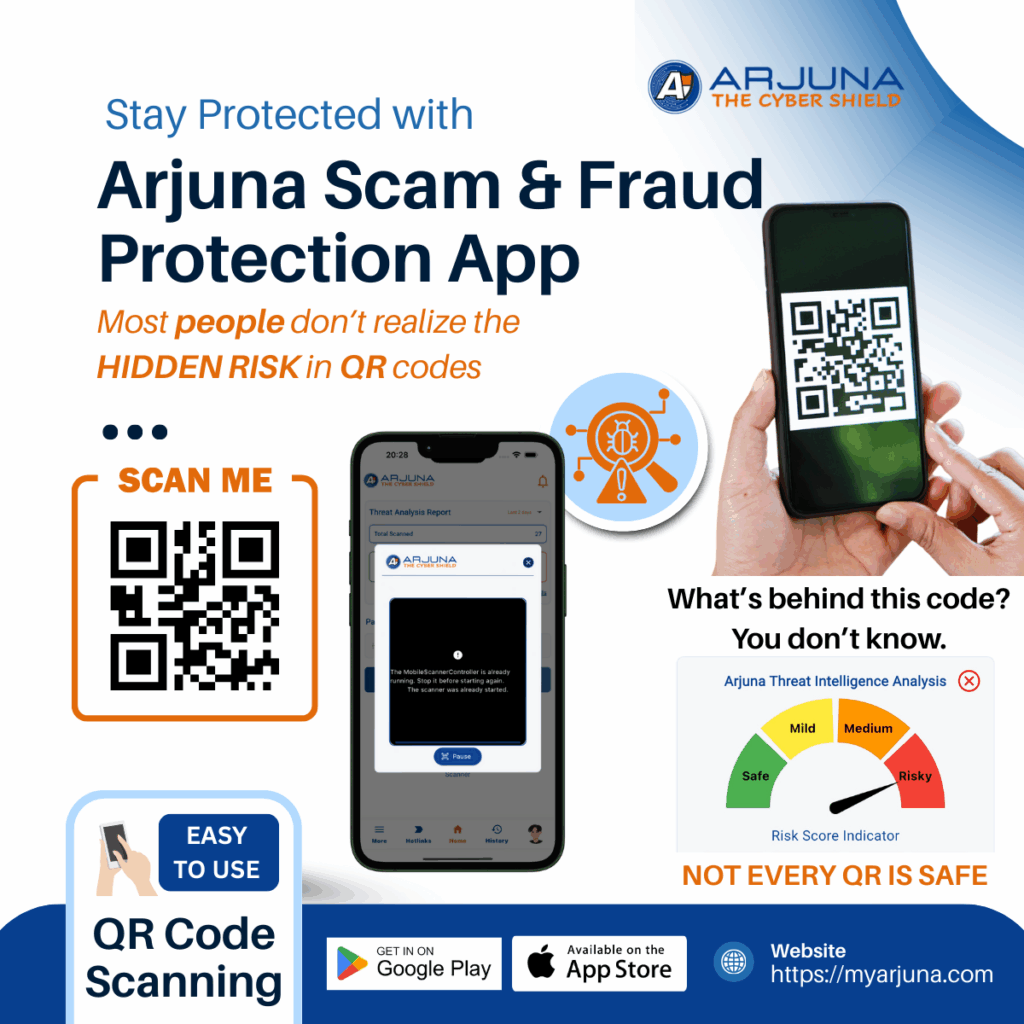
QR codes have transformed payments, shopping, and dining in India — but they also carry hidden dangers. Fraudsters are exploiting restaurant menus, UPI payments, and public QR stickers to launch scams that trick common users into giving away money or personal data. The problem? To the naked eye, a genuine QR and a fake QR look the same. This is why QR scams are rising sharply in India. In this article, we explain how QR codes work, where they’re used, and how scammers misuse them — with real examples like restaurant QR code frauds. More importantly, we show how the Arjuna Scam & Fraud Protection App helps you scan QR codes safely, block malicious links, and stay protected. Don’t let a fake QR put your data and money at risk.

The Cyber War
Arjuna News, Online Protection, Phishing

The Silent War: Cybercrime and Deep Fakes Threaten India’s Soul

The Silent War: Cybercrime and Deep Fakes Threaten India’s Soul It’s 2:44 AM, and somewhere in India, a grandmother’s savings vanish into the ether. A young entrepreneur watches her startup’s reputation crumble under a fabricated video. A soldier’s family receives a chilling call from what sounds like his voice except it’s not him. This isn’t science fiction; it’s our reality in 2025. Cybercrime and deep fakes aren’t just buzzwords anymore, they’re weapons tearing at the fabric of India’s social, economic, and national security. President Droupadi Murmu’s words ring loud and clear: these threats are no longer distant; they’re at our doorstep, and we’re running out of time to fight back. Imagine this: you’re scrolling through your phone, and a video pops up of a politician you trust, urging you to send money for a “national cause.” Except it’s not real. It’s a deep fake, so flawless you’d never suspect it. Or picture a call from your boss, demanding urgent bank details only if it’s an AI mimic, not her voice. These aren’t hypotheticals; they’re happening now. Cybercriminals have turned technology into a battlefield, and we’re all targets. In a nation racing toward digital supremacy, this is the dark underbelly we can’t ignore. Indian President Murmu, addressing Parliament in January 2025, didn’t mince words. “Digital fraud, cybercrime, and emerging technologies like deep fakes pose challenges to our social, economic, and national security,” she said. She’s right our lives are intertwined with the digital world, from UPI payments to DigiLocker. But with every step forward, the shadows grow longer. Scammers don’t need guns anymore; they wield algorithms. They don’t break into homes; they hack into minds. And the cost? Billions of rupees lost, trust shattered, and a nation left vulnerable. But here’s the spark of hope: India isn’t sitting idle. The government’s push for cybersecurity is fierce think tier-1 status in the Global Cybersecurity Index, a badge of honor earned through relentless effort. Measures like the Indian Cyber Crime Coordination Centre and toll-free helplines (1930, anyone?) are lifelines for victims. Cybersecurity isn’t just a tech buzzword here—it’s a job creator, a shield for the youth stepping into this digital warzone. Yet, the enemy evolves faster than we can build defenses. Deep fakes aren’t just videos; they’re psychological warfare, blurring truth until we doubt everything. These aren’t faceless statistics, they’re us. Our parents, our friends, our kids. Cybercrime doesn’t discriminate, and deep fakes make it personal. They steal our voices, our faces, our dignity and we’re left picking up the pieces. So, what do we do? Awareness is our first weapon knowing that a call or video might not be what it seems. The government’s e-governance push, like DigiLocker, is brilliant, but we need more. Stronger AI to fight AI. Training programs for every citizen, not just techies. A culture that questions before clicking. President Murmu’s call to action isn’t just for policymakers—it’s for you and me. This silent war won’t end with a treaty; it’ll end when we refuse to be victims. India’s future is digital, but it’s also fragile. Cybercrime and deep fakes are testing our resilience. Let’s rise, not just as a nation, but as a people—armed with knowledge, united in purpose. The shadows may be long, but our spirit is stronger. India’s future is digital, but it’s also fragile. Cybercrime and deep fakes are testing our resilience. Take control today, download the Arjuna Cyber Shield app and protect yourself from the shadows of this digital war.

Social engineering is a cybercrime method where scammers trick people into sharing confidential information
Arjuna News, Cyber Fraud, Phishing, Smishing

What is Social Engineering and How to Stay Safe

What is Social Engineering? Social engineering is a cybercrime method where scammers trick people into sharing confidential information. They exploit trust, urgency, or fear to get victims to act without thinking. This is one of the most common cyber threats today, as it doesn’t require technical hacking—just deception Understanding Social Engineering: How Scammers Trick You & How to Stay Safe In today’s digital world, cybercriminals don’t always rely on hacking into systems. Instead, they use social engineering, a technique that manipulates human psychology to steal personal data, money, or access to your accounts. Let’s dive into how social engineering works, common tactics scammers use, and how you can stay protected with Arjuna – Your Cyber Shield. Common Social Engineering Scams Here are some of the most common tricks used by scammers: 1️⃣ Phishing Emails & Messages – Fake emails or texts pretending to be from banks, delivery services, or tech companies. These messages contain malicious links that lead to fake websites designed to steal your login credentials. 2️⃣ Fake Websites & Spoofed Links – Scammers create duplicate websites that look just like real ones. You think you’re entering your details on your bank’s website, but in reality, you’re handing them over to hackers. 3️⃣ Impersonation Calls (Vishing) – Cybercriminals pose as bank executives, government officials, or IT support and trick you into revealing sensitive details like OTPs or card information. 4️⃣ Social Media Scams – Fraudsters send messages on WhatsApp, Instagram, or Facebook, offering fake job opportunities, giveaways, or investment schemes to lure victims. 5️⃣ Malware & Ransomware Attacks – Clicking on an unsafe link or downloading an attachment from an unknown source can infect your device, leading to data theft or even financial loss. How to Protect Yourself from Social Engineering Attacks 🔹 Think Before You Click – Always verify links before clicking. Hover over them to see the actual URL or use Arjuna’s AI-powered URL scanner to check for suspicious activity. 🔹 Verify Before Sharing Information – Never share personal details, OTPs, or passwords with unknown callers or via email and SMS. 🔹 Check Website Authenticity – Look for HTTPS in the URL, verify domain spelling, and be cautious of newly registered or poorly designed sites. Arjuna helps you detect malicious websites with its real-time security alerts. 🔹 Stay Alert to Urgency Tricks – Scammers often create a sense of urgency, saying your account will be blocked or your KYC needs immediate updating. Take a pause and verify directly with the official company. 🔹 Use Arjuna for Cyber Protection – Our AI-driven security solution helps detect phishing scams, scans URLs, and provides security alerts so that you can browse safely. Stay Safe with Arjuna – Your Cyber Shield Social engineering attacks are growing every day, but with awareness and the right tools, you can stay protected. Arjuna safeguards you from phishing, fake websites, and cyber threats. Don’t wait until it’s too late—download Arjuna today and make your digital world safer! 🔗 Download Now: https://myarjuna.com/downloads #CyberSecurity #SocialEngineering #PhishingScams #StaySafeOnline #ArjunaCyberShield #OnlineSafety

Think before you click
Arjuna News, Cyber Fraud, Cyber Threat, Phishing, Smishing

The Hidden Dangers of Clicking on Malicious Links

What Is a Risky Link? A risky link is a hyperlink that directs you to an unexpected or potentially harmful webpage. These links can appear deceptively legitimate, but they often lead to sites that trick users into revealing sensitive information or download harmful software onto their devices. While phishing emails and text messages are common sources, risky links can also appear on social media, in comment sections, or even embedded in legitimate-looking advertisements. What Happens If You Click on a Risky Link? Clicking on a malicious link can trigger a chain of harmful events, including: How Do You Avoid Risky Links? Preventing exposure to malicious links starts with adopting cautious online behavior. Here are actionable tips to protect yourself: How Arjuna App Can Break the Chain To help you navigate the web safely, our Arjuna App is here to act as your personal digital guardian. Features of Arjuna App: This app leverages AI-driven algorithms to provide intelligent protection, giving you peace of mind while browsing. Whether you’re shopping online, checking emails, or using social media, Arjuna ensures that malicious links don’t get a chance to compromise your safety. Confidence in Your Online Safety By adopting cautious online habits and leveraging tools like Arjuna, you can greatly reduce your risk of falling victim to cyberattacks. Download the Arjuna App today and take control of your digital safety. https://play.google.com/store/apps/details?id=com.tes.arjuna&hl=en👉 Download Now: https://play.google.com/store/apps/details?id=com.tes.arjuna&hl=en

Arjuna News, Cyber Fraud, fake cbi, Phishing, Scam Messages

A renowned industrialist from Ludhiana gets cyber attacked

Chairperson and Padma Bhushan awardee heading a leading hosiery firm in Ludhiana got subjected to cyber fraud duping him of Rs. 7 crores. Two suspects from Assam and Bengal were arrested after this grave dupery, believably the largest fraud in cybercrime history. CBI is the new sham. As per the revelations of investigators, the fraudsters presented themselves as CBI officials and contacted S.P. Oswal, claiming that his Aadhaar had been misused in cases involving fake documents and financial fraud. The play initiated with an anonymous phone call where the caller portrayed to CBI officer in Mumbai. This call was followed by a video call from same person dressed in uniform with a background showing CBI logo. A trail of fake arrest warrant on WhatsApp chats prevailed to keep SP Oswal in threat. He was assured of genuineness of the forthcoming scam. Oswal was made to transfer Rs 7 crore towards mobilising bail proceedings and fabricating him to be digitally arrested. Without further delay Oswal smelt the scam and his team complained to Ludhiana police. Police Commissioner K.S. Chahal confirmed that their quick action led to quick freezing of scammers’. The scammers had instructed Oswal to transfer 1 crore to one account and remaining 3 in in different transactions to another account as per inspector Jatinder Singh from Ludhiana cybercrime police Even though quick action was taken to freeze the accounts of suspects, the offenders managed to withdraw 1.7 crores before police reaching their accounts.  The police have successfully returned the seized Rs. 5.2crores to the offended party. Before falling prey to any ambiguous WhatsApp direction wanting money transfers, always take help our platform myarjuna.com. Our platform myarjuna.com shall always obstruct you before handedly from sacrificing your hard earned money to such frauds.

Scroll to Top